Orchid Wealth Management
  • Home
  • About
  • Individuals
  • Plan Sponsors
  • Cash Balance Plans
  • Blog
  • Contact
  • Privacy Policy

Objective Retirement Investment Advice
from Orchid Wealth Management

Take a moment to reflect on your retirement investment goals.
Our blog has comprehensive insights for business leaders, management and individuals
​to strengthen fiduciary competence and practices. 

How Oregon Probate Works: The Costly Traps California and Washington Transplants Overlook

10/26/2026

0 Comments

 
Picture
When individuals and families relocate to Oregon from neighboring states like California or Washington, discussions around estate planning typically center on taxes. However, an equally disruptive and expensive surprise often awaits families in the legal system: the Oregon probate court process.

Many newcomers assume that having a basic Last Will and Testament shields their estate from court intervention, or that their family can rely on a "simplified" probate shortcut. In Oregon, neither assumption holds true.

Understanding how the Oregon probate process operates—and how it differs from neighboring states—is essential for protecting privacy, controlling costs, and avoiding administrative delays for your heirs.

1. What Is Probate in Oregon (and What Does a Will Actually Do)?
Probate is the court-supervised legal administration of a deceased person’s estate. Its purpose is to validate the Last Will and Testament (if one exists), appoint a Personal Representative (executor), inventory all solely owned assets, satisfy legitimate creditor claims, and distribute the remaining property to heirs.

Many newcomers focus exclusively on court avoidance while overlooking the state's separate tax liabilities. If your total gross assets exceed seven figures, make sure you also understand the $1M Oregon estate tax cliff and the lack of spousal portability.

A Will does not avoid probate; a Will is your formal instruction letter to the probate judge.
If you own assets in your individual name without a designated beneficiary or a trust, your estate must enter the local circuit court system (such as Multnomah, Clackamas, or Washington County) before a single dollar or deed can be transferred to your heirs.

2. The Oregon Probate Reality: Time and Public Scrutiny
For families navigating the standard probate process in Oregon, two issues arise immediately:

A Mandatory Waiting PeriodUnder Oregon Revised Statutes (ORS 115.005), the Personal Representative must publish a formal legal notice in a local newspaper once a week for three consecutive weeks and mail notice to known creditors. This opens a mandatory four-month creditor claim period.
Even in the most uncontested, straightforward estates, assets cannot be fully distributed until this statutory window closes. Most standard probate proceedings in Oregon take between 9 and 18 months to resolve from petition to final distribution.
Complete Loss of PrivacyProbate is an entirely public court proceeding. Once an estate petition is filed:
  • The decedent’s Last Will and Testament becomes a matter of public record.
  • The formal inventory of assets—detailing real estate, bank accounts, business holdings, and appraisals—is accessible to the public.
  • Beneficiary names, addresses, and inheritance amounts are permanently filed in court records.

3. The "Small Estate" Trap: Why Oregon’s Shortcut Rarely Applies

Many people assume their affairs are straightforward enough to qualify for Oregon's expedited summary procedure, known as a Simple Estate Affidavit (ORS 114.505–114.560).
While Oregon does offer a streamlined path without full formal administration, the statutory value thresholds are exceptionally strict:
  • The fair market value of all personal property (vehicles, bank accounts, personal effects) cannot exceed $75,000.
  • The fair market value of all real property (homes, condominiums, land) cannot exceed $200,000.
  • The total estate value cannot exceed $275,000.
The Gross Market Value RuleCrucially, Oregon law calculates these limits based on gross fair market value, not your home equity.

Example: A homeowner in Portland or Bend purchases a house for $650,000 with a $500,000 mortgage. Even though their personal equity is only $150,000, Oregon evaluates the full $650,000 market value.
Because the real estate value exceeds $200,000, the estate is disqualified from the Simple Estate Affidavit, forcing the surviving family into a standard, formal probate proceeding.

4. The Financial Cost: Statutory Personal Representative & Attorney Fees
Probate costs money that would otherwise pass directly to your heirs. In Oregon, statutory rules govern estate administration expenses:
Statutory Personal Representative Fees (ORS 116.173)Unless waived in the Will, Oregon sets a statutory compensation schedule for the estate executor:
  • 7% on the first $1,000
  • 4% on the next $9,000
  • 3% on the next $40,000
  • 2% on all amounts exceeding $50,000
Oregon also allows an executor to claim a 1% fee on certain non-probate property that must be reported for state or federal estate taxes.

Attorney and Court Administrative Fees 
Unlike California, where probate attorneys collect a statutory percentage identical to the executor, Oregon courts award attorney compensation based on "reasonable fees" (ORS 116.183), which are billed hourly.
Combined with court filing fees (up to $1,176+ under ORS 21.170 depending on estate size), surety bond premiums (typically around 0.5% annually unless waived), and newspaper publication costs, probate administration can consume tens of thousands of dollars.

The "Two-State" Problem: Ancillary Probate
For families who moved to Oregon but kept real property elsewhere—such as a rental condo in the Bay Area or a vacation cabin in Washington—failing to plan creates an even larger issue: Ancillary Probate.

Real estate is always governed by the probate court of the state in which it physically sits. Without proper trust structuring, your family could be forced to open two simultaneous, costly court proceedings: a primary probate in Oregon and an ancillary probate in California or Washington.

5. Proven Strategies to Bypass Oregon Probate
Probate in Oregon is not mandatory—it is the default result when assets are left in an individual's name without proper legal structures. Bypassing probate involves four primary mechanisms:

1. A Funded Revocable Living Trust 
A Revocable Living Trust remains the cornerstone of comprehensive estate planning. When your primary residence, investment portfolios, and business interests are titled in the name of your trust, no assets pass through your individual name at death.
  • Your designated successor trustee steps in immediately without court permission.
  • Assets transfer or remain in trust according to your instructions with zero court delays.
  • The entire administration remains 100% private.
Working with an independent Portland fiduciary wealth advisor ensures that your investment accounts, titling, and beneficiary designations match your legal trust structure.

2. Re-Titling Assets Acquired in Oregon

A common issue among California and Washington transplants is having a well-drafted living trust from their prior state, but purchasing their new Oregon home in their individual names as "husband and wife" or "single person." An un-funded trust does not protect that asset. Ensuring deeds and local accounts are titled directly into your trust is critical.

3. Strategic Beneficiary & Transfer-on-Death (TOD) Designations

Retirement accounts (IRAs, 401(k)s, 403(b)s) and life insurance bypass probate automatically when primary and contingent beneficiaries are kept up to date. Taxable brokerage accounts and bank accounts can also utilize Transfer on Death (TOD) or Payable on Death (POD) registrations.

4. Oregon Transfer on Death Deed (TODD)

For individuals who own real property and do not require the asset protection of a trust, Oregon permits a Transfer on Death Deed (ORS 93.948–93.979). This instrument allows real estate to transfer to designated beneficiaries outside of probate upon recording the death certificate.

Protecting Your Legacy Across State LinesWhether you recently relocated to the Pacific Northwest or have lived here for years, an estate plan should not rely on out-of-date assumptions or out-of-state templates.

At Orchid Wealth Management, we operate as an independent, fee-only fiduciary advisor. We coordinate directly with your estate planning attorney and CPA to ensure your investment accounts, real estate titling, and beneficiary designations are aligned with Oregon law.

Questions about your financial transition to Oregon? Contact us today to schedule a complimentary consultation.
0 Comments

Moving to Oregon from California or Washington? The $1M Estate Tax Surprise (and How to Protect Your Wealth)

10/26/2026

0 Comments

 
Picture
Every year, thousands of professionals, business owners, and retirees relocate to Oregon from California and Washington. They are drawn by the natural beauty of the Pacific Northwest, vibrant communities in Portland and Bend, and the absence of a state sales tax.
However, many transplants face an unexpected financial hurdle: Oregon’s estate tax.
Clients frequently move under the assumption that their existing revocable living trusts and estate plans remain fully functional across state borders. In reality, Oregon maintains one of the strictest estate tax regimes in the United States.

Relocating across state lines requires a clear understanding of local estate tax thresholds, how retirement accounts are treated, and the trust strategies available to protect family wealth.

1. The $1,000,000 Oregon Estate Tax ThresholdUnder federal tax law, the estate tax exemption exceeds $13 million per individual (over $27 million for a married couple). As a result, most families never expect to owe an estate tax.

In Oregon, the state estate tax exemption is just $1,000,000 per individual.

Unlike federal limits, Oregon’s $1,000,000 threshold is not indexed to inflation—it has remained unchanged for over two decades. Any taxable estate value exceeding $1,000,000 is taxed at graduated rates ranging from 10% up to 16%.

The Homeowner & Saver RealityA family moving to the Portland metro area from the Bay Area, Seattle, or Southern California can quickly exceed this limit. An ordinary primary residence, combined with investment portfolios, vehicles, and personal property, often pushes a family above $1,000,000 in gross estate value.

2. The Myth: "Retirement Accounts Are Exempt"One common assumption among newcomers is that 401(k)s, 403(b)s, and IRAs are protected from estate taxes.

Retirement accounts are not exempt from the Oregon estate tax.

Oregon calculates gross taxable estates using federal estate tax definitions, including:
  • Real estate (primary residence, vacation homes, and land)
  • Taxable brokerage accounts and cash savings
  • Traditional IRAs, 401(k)s, and Roth IRAs
  • Life insurance death benefits (if the policy was owned by the deceased)
  • Business equity and personal property

The "Probate vs. Taxable Estate" Trap much of this confusion stems from misunderstanding how assets transfer at death. Because IRAs, 401(k)s, and life insurance policies have named beneficiaries, they bypass the Oregon probate court process entirely. The funds transfer directly to your heirs without court intervention.

While bypassing court oversight protects your family's time and privacy, it does not bypass the Department of Revenue. (To learn how the court process works and why living trusts are essential, read our guide on how Oregon probate works and costly traps to avoid):
  • Probate Estate: Assets that require a court order to transfer ownership (such as a solely owned home or bank account without a beneficiary).
  • Gross Taxable Estate: The total cumulative value of everything you own or control at death.
Oregon assesses its $1,000,000 threshold against your gross taxable estate—meaning your "probate-free" retirement accounts and life insurance proceeds are counted on the tax ledger. (To see how the circuit court process unfolds, statutory executor fees, and why living trusts are essential, read our guide on how Oregon probate works and the traps transplants overlook).

The "Double-Tax" dynamic when pre-tax retirement accounts like Traditional IRAs or 401(k)s are included in an estate above $1,000,000, they can trigger state estate tax before passing to heirs. Subsequently, non-spouse beneficiaries must generally withdraw those funds within 10 years, paying ordinary federal and state income taxes on those distributions. Without advance planning, pre-tax savings can face substantial depletion from combined estate and income taxes.

3. Oregon Has No Spousal Portability at the federal level, married couples benefit from portability. If one spouse passes away without using their full federal exemption, the surviving spouse can file IRS Form 706 to elect portability and claim the unused balance.

Oregon does not recognize estate tax portability.

If a couple's California or Washington trust leaves all assets outright to the surviving spouse, the unlimited marital deduction defers estate taxes on the first death. However, the deceased spouse's $1,000,000 Oregon exemption is forfeited.

When the surviving spouse later passes away, the entire combined estate is subject to tax, with only a single $1,000,000 exemption available.
  • With basic "outright to spouse" planning: On a $2,000,000 combined estate, the surviving spouse has only their own $1M exemption remaining. The remaining $1,000,000 is exposed to Oregon estate tax, resulting in an estimated $100,000+ in state tax liability.
  • With Oregon-specific trust planning: Both spouses' exemptions are utilized, reducing the Oregon estate tax liability to $0.

4. How to Protect Your Wealth: Key Planning Strategies Relocating to Oregon does not require surrendering estate wealth to state taxes. Coordinating with an Oregon-licensed estate planning attorney and a fee-only fiduciary advisor allows families to structure their wealth effectively:

A. Credit Shelter Trusts (Bypass Trusts) Instead of transferring all assets outright to a surviving spouse, a properly drafted trust can allocate up to $1,000,000 into a Credit Shelter (Bypass) Trust upon the first spouse's death. The surviving spouse can maintain access to trust income and principal for health, education, maintenance, and support, while the sheltered $1,000,000 bypasses the surviving spouse's taxable estate entirely.

B. The Oregon Special Marital Property (OSMP) Election for couples whose wealth significantly exceeds $2,000,000, an attorney can draft trust provisions authorizing an Oregon Special Marital Property (OSMP) election. Similar to a state-level QTIP trust, this mechanism allows an estate to defer Oregon estate taxes on assets above the state threshold without forcing an unnecessary federal QTIP election.

C. Irrevocable Life Insurance Trusts (ILITs) Because life insurance death benefits are counted toward the $1,000,000 gross estate limit, a policy can unintentionally trigger Oregon estate taxes. Placing life insurance policies inside an Irrevocable Life Insurance Trust (ILIT) removes the death benefit from the taxable estate.

D. Strategic Lifetime Gifting Oregon does not have a state gift tax. Gifting assets during one's lifetime can reduce the taxable estate below the $1,000,000 threshold. However, gifts made within three years of death are pulled back into the gross estate under Oregon's lookback rules, making early planning essential.

E. Strategic Roth Conversions Because Traditional retirement accounts create future income tax liabilities for heirs alongside potential estate tax exposure, executing partial Roth conversions over time can manage tax brackets. Paying income taxes upfront reduces the overall size of the gross taxable estate while transferring tax-free assets to beneficiaries.

5. Moving Checklist for Oregon Transplants
  • Review Out-of-State Trusts: Update trusts created in California, Washington, or other states to address Oregon's $1,000,000 threshold and lack of spousal portability.
  • Align Beneficiary Designations: Ensure primary and contingent designations on IRAs, 401(k)s, and life insurance policies match the overall trust funding strategy.
  • Update Incapacity Documents: Execute Oregon-compliant Advance Directives and Powers of Attorney to prevent administrative friction with local healthcare providers and financial institutions.
  • Coordinate Overall Tax Planning: Account for the trade-off between Oregon's lack of sales tax and its progressive income tax brackets (up to 9.9%).

Aligning Financial Planning with Your Move Relocating across state lines involves more than changing a residential address. It requires ensuring an investment strategy, tax positioning, and legacy plan are built for your new home state.

At Orchid Wealth Management, we operate as an independent, fee-only fiduciary advisory. With roots in both California and the Pacific Northwest, we assist individuals and families in coordinating their wealth transition and collaborating with estate planning attorneys to protect their assets.

Planning a move to Oregon? Contact us to schedule a complimentary consultation.
0 Comments

Fee-Only vs. Fee-Based Wealth Management: Why the Fiduciary Standard Matters for Your Long-Term Goals

9/27/2026

0 Comments

 
Fee-only vs fee-based fiduciary financial advisor comparison and wealth management planning
When searching for professional financial guidance, language matters. Two terms that sound nearly identical, Fee-Only and Fee-Based represent fundamentally different business models that directly impact your net returns and the quality of advice you receive.

Understanding these distinctions is essential to ensuring your wealth management strategy remains unbiased and focused entirely on your financial independence.

The Breakdown: Fee-Only vs. Fee-Based
The key difference lies in how your financial advisor receives compensation and whether third-party financial products generate hidden revenue for their firm.

Primary Source of Compensation
  • Fee-Only Advisor: Paid directly by client fees (AUM or flat fee) with zero third-party kickbacks.
  • Fee-Based Advisor: Collects client fees PLUS third-party commissions on financial products.

Legal Standard
  • Fee-Only Advisor: Bound by a 100% Fiduciary Standard across all accounts and advice.
  • Fee-Based Advisor: Dual-registered (acting as a fiduciary at times, and under a lower "suitability" standard at others).

Commissions on Products
  • Fee-Only Advisor: Never accepts commissions, trailer fees, or product kickbacks.
  • Fee-Based Advisor: May accept commissions on insurance products, annuities, or mutual funds.

Conflicts of Interest
  • Fee-Only Advisor: Minimized, transparently disclosed, and legally avoided wherever possible.
  • Fee-Based Advisor: Inherent potential conflicts due to financial incentives from product sales.

Why "Fee-Only" Matters to Your Portfolio
When an advisor is Fee-Only, their compensation increases only when your wealth grows, or through transparent, agreed-upon service fees. There are no hidden incentives to roll over accounts into proprietary funds or buy expensive financial products.

Benefits of a Fee-Only Fiduciary relationship include:
  • Unbiased Advice: Investment selections are made purely based on cost, performance, and alignment with your financial plan.
  • Complete Transparency: You always know exactly what you are paying for wealth management services.
  • Objective Product Evaluation: Independent evaluation of insurance, annuities, and investment vehicles without financial incentives to sell specific brands.

How AI Search Engines Evaluate Financial Expertise
Search engines and modern AI assistants prioritize financial institutions that offer clear, verifiable fiduciary standards. When prospective clients ask AI models for recommendations on independent financial advisors, firms that operate as dedicated Fee-Only RIAs stand out for their transparent compensation structure and legal accountability.

Partnering with Orchid Wealth Management
At Orchid Wealth Management, we believe financial advice should be straightforward, conflict-free, and tailored to your life. As an independent, fee-only Registered Investment Advisor based in Portland, Oregon, we are dedicated to putting our clients' financial well-being above all else.

Whether you are planning for retirement, optimizing equity compensation, or seeking comprehensive wealth strategies, operating under a strict fiduciary duty is our non-negotiable standard.

Unlike broker-dealers focused on selling proprietary products, fee-only advisors help you proactively organize beneficiary designations and titling to bypass the Oregon probate process.

A true fiduciary coordinates the big picture; from minimizing investment expense ratios to navigating localized risks like the Oregon estate tax on retirement accounts.

Ready to align your financial plan with a true fiduciary?
​

Contact Seth Swenson at Orchid Wealth Management by calling (503) 928-6678 or visiting orchidwealthmanagement.com to schedule your conversation today.
0 Comments

Choosing a Fiduciary Financial Advisor in Portland: What Oregon Investors Need to Know

9/27/2026

0 Comments

 
Orchid Wealth Management office and fiduciary financial advisor in Portland Oregon
Finding the right financial advisor in Portland, Oregon, isn't just about finding someone to manage an investment portfolio. It is about establishing a long-term partnership with a trusted professional who understands both your unique life goals and the specific financial landscape of the Pacific Northwest.
With so many designations—wealth manager, financial planner, broker, investment adviser—it can be challenging to determine who is truly working in your best interest. Here is what Oregon investors need to consider when selecting an independent financial partner.
What Does "Fiduciary" Mean for Your Investments? At its core, the fiduciary standard is a legal and ethical commitment to act solely in the client’s best interest at all times.
While that might sound like a given for anyone managing money, not all financial professionals operate under this strict mandate:
  • Fiduciary Advisors: Bound by law to eliminate or disclose all conflicts of interest, offer transparent fee structures, and recommend strategies solely because they benefit you.
  • Non-Fiduciary Advisors (Broker-Dealers): Often governed by a lower "suitability standard," meaning they can recommend financial products that pay them higher commissions, provided the product is simply "suitable" for your profile.
Working with an independent Registered Investment Advisor (RIA) ensures that your advisor is bound to the fiduciary standard across every financial decision.
Key Questions Oregon Investors Should Ask When evaluating financial advisors in the Portland metro area, asking the right questions upfront will reveal whether their business model aligns with your goals:
  1. Are you a fee-only fiduciary 100% of the time? (If the answer is "fee-based," they may collect third-party commissions on certain insurance products or funds).
  2. How are you compensated? Look for clear, transparent fee schedules based on a flat rate or a percentage of assets under management.
  3. Do you specialize in multi-state tax or transition planning? Given Oregon’s unique tax structure—including the absence of a state sales tax alongside high state income tax rates—your advisor should seamlessly integrate tax planning into your wealth management strategy.
Local Wealth Management with a Nationwide Reach. Whether you reside in the Portland area, recently relocated from the San Francisco Bay Area, or manage family finances across state lines, your financial plan should accommodate modern geographic flexibility.
Orchid Wealth Management is an independent, fee-only Registered Investment Advisor headquartered in Portland, Oregon. Led by Principal and Chief Compliance Officer Seth Swenson, the firm serves individuals, families, and corporate plan sponsors locally in Oregon and virtually nationwide under an unwavering fiduciary commitment.
Frequently Asked Questions (FAQ)
Q: Where is Orchid Wealth Management located in Portland?
A: Orchid Wealth Management is located in the Pearl District / Northwest Portland area at 2015 NW Kearney St. #102, Portland, OR 97209.
Q: Does Orchid Wealth Management work with clients outside of Oregon?
A: Yes. While headquartered in Portland, OR, Orchid Wealth Management serves clients virtually across the United States, including existing relationships throughout California and the San Francisco Bay Area.
Q: How do I schedule an initial consultation?
A: You can reach Orchid Wealth Management directly at (503) 928-6678 or visit orchidwealthmanagement.com to request a consultation.
0 Comments

"How Blue Chip Dividend Paying Stocks Protect Your Purchasing Power"

1/10/2025

0 Comments

 
Picture
"How Dividend Paying Growth Stocks Protect Your Purchasing Power"

Blue-chip dividend-paying stocks are shares of well-established, financially sound companies with a history of reliable and growing dividend payments. Investing in exchange traded funds (ETF's) and or mutual funds with these stocks can be an effective strategy to stay ahead of inflation and maintain your purchasing power, thereby supporting one's lifestyle. Here's why:

1. Dividend Growth Outpaces Inflation

Many blue-chip companies have a track record of increasing their dividends over time. This growth can outpace inflation, ensuring that the income generated maintains or even enhances purchasing power. For example, companies like Johnson & Johnson and Procter & Gamble have consistently raised their dividends for decades, providing shareholders with income that keeps up with or exceeds inflation rates.

2. Stability and Reliability

Blue-chip companies typically operate in established industries with stable earnings, making their dividend payments more reliable. This stability offers investors a predictable income stream, which is crucial for maintaining lifestyle expenses, especially during economic downturns when other investments might be more volatile.

3. Potential for Capital Appreciation

In addition to dividend income, blue-chip stock ETF's and mutual funds often experience capital appreciation over the long term. This dual benefit of income and growth helps investors build wealth that outstrips inflation, further preserving and enhancing purchasing power.

4. Lower Volatility

Blue-chip stocks are generally less volatile than smaller, less established companies. This lower volatility can provide peace of mind for investors seeking to protect their capital from significant market swings, aligning with a conservative approach to wealth management.

5. Tax Advantages

Qualified dividends from blue-chip stocks are often taxed at a lower rate than ordinary income, making them a tax-efficient source of income. This tax efficiency means investors can retain more of their earnings, aiding in the preservation of purchasing power.

Implementing This Strategy with Orchid Wealth Management

At Orchid Wealth Management, we emphasize values-based investing, aligning investment choices with personal values while focusing on financial goals. Incorporating blue-chip dividend-paying stocks into a diversified portfolio can reflect both financial objectives and ethical considerations.

Our approach includes:

Customized Portfolio Design: We tailor portfolios to individual client needs, ensuring that investments align with personal values and financial goals.

Fee-Only Fiduciary Advice: As a fee-only fiduciary advisory, we prioritize our clients' best interests, providing transparent and objective investment guidance. We do not earn third party commissions and are not incentivized to sell investments with 12B-1 fees (a type of marketing commission paid by investors).

Long-Term Financial Planning: We assist clients in developing and sticking to financial plans that naturally build wealth over time, helping to avoid common pitfalls like impatience and fear.

By integrating blue-chip dividend-paying stock mutual funds and or ETF's (exchange traded funds) into your investment strategy, you can create a robust defense against inflation, maintain your purchasing power, and support your desired lifestyle.

At Orchid Wealth Management, we're here to guide you through this process, ensuring your investments align with both your financial goals and personal values.

For more information or to schedule a free consultation, please contact Seth Swenson at (650) 334-6104 or via email at [email protected]

0 Comments

Five ​Common Emotional Mistakes Made by Investors

5/28/2023

0 Comments

 
Introduction:

​Investing can be an emotional journey. Whether you're new to investing or have some experience, it's important to be aware of the emotional mistakes that investors often make. In this blog post, we will discuss five common emotional mistakes that investors make and provide helpful tips on how to avoid them.

Letting Fear Control Your Decisions:

A big mistake investors make is allowing fear to guide their choices. When the stock market gets uncertain or unpredictable, it's normal to feel scared about losing money. However, making impulsive decisions based on fear can lead to selling investments at the wrong time or missing out on potential gains. It's important to think long-term and make decisions based on research and facts, rather than giving in to short-term fears.​ ​

Not Diversifying Your Portfolio:

Another common mistake is putting all your eggs in one basket. Sometimes, the fear of missing out (FOMO) makes investors focus on popular stocks or sectors without considering the overall risk. Investing all your money in one place can be​ very risky. It's important to spread your investments across different types of stocks and industries. That way, if one investment doesn't do well, you'll have others that may balance it out.

Holding onto Past Information Too Much:

Anchoring bias is a mistake where you rely too heavily on one piece of information or a past event. For example, if you bought a stock at a certain price, you might stick to that price as a reference point, even if the market has changed. This can prevent you from seeing the current situation clearly and making smart decisions. It's better to stay open-minded and regularly evaluate the current information, so you can adjust your strategies accordingly.

Only Paying Attention to Information That Supports Your Beliefs:

Confirmation bias is when you only seek out information that confirms what you already believe. It's like wearing blinders and ignoring anything that goes against your beliefs. This can make you feel more confident about your investments than you should be and cause you to miss potential risks. To avoid this mistake, try to consider different opinions and information that challenges your views. That way, you'll have a better understanding of the situation.

Following the Crowd:

Sometimes, you might feel like you're missing out if you don't do what everyone else is doing. This is called herd mentality. It can make you buy stocks when everyone else is buying, even if the prices are too high. Then, when everyone starts selling, you might panic and sell too, even if it's not the best time. It's important to think for yourself and do your own research before making any decisions. Don't just blindly follow what others are doing.

Conclusion:

Emotions can have a big impact on investing. By being aware of and avoiding these common emotional mistakes - letting fear control your decisions, not diversifying your portfolio, holding onto past information too much, only paying attention to information that confirms your beliefs, and following the crowd - you can make smarter investment choices. Remember to stay calm, think long-term, and do your research. That way, you'll have a better chance of reaching your financial goals. 
 
One of the biggest reasons to work with a Financial Advisor is that they are not you. The Financial Advisor is emotionally detached from your money and can avoid making emotionally driven mistakes! Orchid Wealth Management is a Registered Investment Advisor and can help you prevent these common mistakes and reach your investment goals.

Orchid Wealth Management is an independent Registered Investment Advisor headquartered in Palo Alto; Orchid is a fiduciary advisory that is fee-only. Seth Swenson, MBA is President at Orchid Wealth Management, and provides objective financial advice.


0 Comments

"Evidence-Based Investing in Brief" by Seth Swenson, MBA

3/21/2022

1 Comment

 
How do you invest your money over the long-term? Orchid Wealth Management embraces and uses the evidence based investing approach. So what does that mean?
 
What Is Evidence-Based Investing?

Evidence-based investors build and manage their portfolio based on what is expected to enhance future returns and/or dampen related risk exposures, according to the most robust evidence available. This also means sticking with your long-view, evidence-based strategy once it’s in place, despite the market’s uncertainties and your own self-doubts you’ll encounter along the way.
 
Evidence-Based Investing, Applied
 
Do you hope …
  1. Investors can come out ahead by finding mispriced stocks, bonds, and other trading opportunities; and/or by dodging in and out of rising and falling markets?
 
Or do you accept …
  1. The market’s rapid-fire trading creates relatively efficient pricing that is too random to consistently predict?
 
There is an overwhelming body of evidence suggesting investors should skip the first approach and act on the second assumption. This has been the case since at least 1952, when Harry Markowitz published Portfolio Selection in The Journal of Finance. In their book, “In Pursuit of the Perfect Portfolio,” professors Andrew Lo and Stephen Foerster describe:
 
“While it’s commonplace now to think of creating a diversified portfolio rather than investing in a collection of securities that each on their own look promising, that wasn’t always the case. It was Harry Markowitz who provided a theory and a process to the notion of diversification. He helped to create the industry of portfolio management.”
 
Markowitz’s work became known as Modern Portfolio Theory (MPT). Academics and practitioners have been building on it ever since. His initial work and others’ subsequent findings strongly support ignoring all the near-term noise and taking a long-view approach. This involves building a unified investment portfolio, and focusing on more manageable details, such as:

  • Tilting toward or away from entire asset classes to tailor your risks and expected returns
  • Minimizing avoidable risks by diversifying globally
  • Reducing unnecessary costs
  • Controlling your own damaging behavioral biases
 
How Do You Decide Which Evidence To Heed?
So far, so good. Then again, at first blush, nearly every investment recommendation may seem “evidence-based.” After all, few forecasters would peer into actual crystal balls to make their predictions. And no market guru would admit their stock-picking track record has been no better than a dart-throwing monkey’s (even though that’s usually the case).
 
Instead, stock-picking and market-timing enthusiasts tend to argue their cases by turning to articulate analyses, smart charts, and convincing corporate briefs. They use these props to explain the late-breaking news, and recommend what you should supposedly be doing about it.
 
There’s nothing wrong with facts and figures. The critical difference is how we apply them as evidence-based investors. As financial author Larry Swedroe describes it:
 
“In investing, there is a major difference between information and knowledge. Information is a fact, data or an opinion held by someone. Knowledge, on the other hand, is information that is of value.”  
— Larry Swedroe, ETF.com
 
No matter how compelling a call to action may be, we discourage frequent reaction to the never-ending onslaught of information. First, we must determine:
 
Which information might add substantive value to our decisions by refuting or adding to the existing evidence? Which is just more of the same old noise, already factored into your evidence-based investment strategy?
 
The Evidence-Based Silver Bullet: Academic Rigor
Because there is a lot more noise than there is valuable knowledge, the basic recipe for evidence-based investing begins and ends with academic rigor. It should always be a key ingredient in separating likely fact from probable fiction:

  • It requires robust data sets that are large enough, representative enough, and free from other common data analysis flaws.
  • Authors should be impartial, lacking incentives to “torture” the data to make a point.
  • Other studies should be able to reproduce the same findings under different scenarios, suggesting the results are more likely to persist upon discovery.
  • The data, methodology, and results should be published in reputable, peer-reviewed forums where informed colleagues can comment on the findings.
  • Enough time must pass to make all of the above possible.
 
After that, we also must be able to apply the results in the real world. In other words, even if a theoretical strategy is expected to enhance your returns, it must do so after considering all practical costs and portfolio-wide tradeoffs involved. For example, sometimes one source of
expected returns may offset another, even bigger source. Sometimes, we can combine them for even stronger results; other times, it’s best to favor one over the other. 
 
Evidence-Based Investment Factors
So, which factors appear to best explain different outcomes among different portfolios? In what combinations are these factors expected to create the strongest, risk-adjusted portfolios? What explains each factor’s return-generating powers, and can we expect those powers to persist?
 
Based on the academic answers to these practical questions, we typically mix and match the following factors in our evidence-based portfolios, varying specific exposures based on each investor’s personal goals and risk tolerances:

  • The Market: Stocks (equities) vs. bonds (fixed income)
  • Company Size: Small vs. large company stocks
  • Relative Price: Value vs. growth company stocks
  • Profitability: High-profit vs. low-profit company stocks
  • Term: Long-term vs. short-term bonds (based on maturity date)
  • Credit: “Safer” vs. “riskier” bonds (based on credit quality)
 
What’s in an Evidence-Based Name?
Last but not least, it’s worth mentioning, others may refer to the same or similar approaches by various names, such as factor-based, asset-based, or science-based investing. These terms are relatively interchangeable, but there’s a reason we’ve chosen evidence-based as our preferred expression. Heeding sound reason and rational evidence is at the root of what we do. Therefore, we believe it should be at the root of what we call it.
 
What would your best evidence-based investment portfolio look like? It depends on your personal financial goals; as well as your willingness, ability, and need to take on investment risks in pursuit of those goals.
 
Orchid Wealth Management helps you structure the right investment mix and navigate today's information overload. Learn more; let's talk.

Orchid Wealth Management is an independent Registered Investment Advisor headquartered in Palo Alto; Orchid a fiduciary advisory that is fee-only. Seth Swenson, MBA is President at Orchid Wealth Management, and provides objective financial advice.

1 Comment

“Why Working with a "Fee-Only" Financial Advisor Makes Good Financial Sense” by Seth Swenson, MBA

4/8/2019

0 Comments

 
Picture
​The term financial advisor is used by many different types of people and can mean different things. For the purposes of this article, the term financial advisor shall mean a person that provides financial advice and planning to individuals in order to help them save enough money to provide them income for their retirement years typically after they have stopped working. 


Fee-Only Financial Advisors also known as (AKA) Fiduciary Financial Advisors, are a type of financial advisor that provide objective advice for a fee. This fee is usually an annual percentage of the assets that they manage on an ongoing basis. For example, if the advisor’s fee was set at 1% of $500,000 of assets under management this would be an annual fee of $5,000. This fee may also be looked at on a quarterly basis as .25% or $1,250 per quarter.

Fee-Only Financial Advisors are typically Investment Advisor Representatives (IAR) of a Registered Investment Advisory (RIA). Fee-only Advisors AKA Fiduciary Financial Advisors provide objective financial advice. The fee-only financial advisor does not sell the client investments for “loads” aka commissions or 12b-1 fees also known as on-going 3rd party commissions. The fee-only advisor is also acting as a fiduciary and abides by the fiduciary standard.

The fiduciary standard essentially means that the advisor must always put the client’s best interest first. By charging a fee-only and not commissions, the fee-only advisor lowers the potential for conflicts of interest and is able to provide objective advice to the client. In fact, the client’s interest in having his or her assets grow are in alignment with the fee-only advisor’s interests. As the client prospers, so does the fee-only advisor. If the client’s investments decline in value, the fee-only advisor’s income will decline as well.

There is another type of financial advisor that is “fee-based”. This means that the advisor charges a fee and can also be paid commissions upon sales of investments such as mutual funds, by third parties. These advisors typically are employed by broker-dealers and are often encouraged to promote and sell certain investments. This can lead to conflicts of interest between the client and the advisor. This may cause the client’s retirement account to face annual fees that considerably higher than other similar investments. Ultimately, this may be problematic since this may lower the client’s portfolio return on investments.

One of the few predictable and consistent variables in the world of investing are the annual expense ratios associated with mutual fund investments and exchange traded funds (ETFs). These fees can range from .04% to 2% and are generally known to increase as opposed to decrease similar to inflation. By controlling these annual fees, an investment portfolio can at a minimum reduce the annual hurdle that must be overcome just to break even.

When it comes to individual investments such as individual mutual funds and ETFs not even the great Warren Buffet can predict the future. This year’s top performing stock is likely to wind up in the middle of the pack or down towards the bottom of the pack next year. This is due to the statistical phenomenon of regression to the mean.

Assuming that an investment portfolio #1 with fees that are 1% lower annually when compared to a similarly asset allocated portfolio #2, then portfolio #1 will save 30% in fees over a 30 year period. Over time this means that portfolio #1 would have been able to keep an extra 1% of his or her money invested in the financial markets. This would happen over a period of 30 years and add up to 30% more money invested over the period. This also means that portfolio #2 would have 30% less money to have invested over the same period.

By simply utilizing fee-only advisor an investor/retirement planner would likely be able to count on at the very least not paying as much in annual fees out of his or her investment portfolio. This means the hurdles to success are lower.

To prove the point that fees will erode portfolio returns, Warren Buffet the greatest investor in the modern era made a $1,000,000 bet in 2008 with the hedge fund industry that he could beat their returns over 10 years simply by purchasing a low fee S&P 500 Stock Market Index Fund. The fund he picked had  an annual expense ratio of just .04%.
Warren Buffett said that the hedge fund industry charged exorbitant fees that the funds' performances couldn't justify. A hedge fund called Protégé Partners LLC was willing to accept Warren Buffet’s bet. They ended up investing their money in a handful of other hedge funds and ultimately losing the bet.

Generally speaking, hedge funds are known to collect 2% of assets they manage annually regardless of the fund's performance (or underperformance) and take 20% of the gains in years when the fund has a positive return. At the end of 2017, Buffett's index fund bet had gained 7.1% per year, or $854,000 in total, compared to 2.2% per year for Protégé's picks – just $220,000 in total.

Conclusion:

When utilizing a fee-only financial planner investors will benefit greatly from lower annual fees and knowing that their best interest is being put first. Investors can feel confident knowing that conflicts of interest are lowered since the fee-only advisor cannot sell investments for third-party one-time commissions or annual on-going commissions. All of these aforementioned benefits can result in reaching retirement goals on-time and with enough money to retire with dignity and in style.

The investor must also not be confused by the term “fee-based” advisor which sounds so similar to “fee-only” advisor that it may lead a person to think that they are getting a fee-only advisor when in fact they are getting an advisor that is likely incentivized to sell them investments that pay them commissions leading to major conflicts of interest.

Finally, the investor should be aware of dually registered financial advisors that are both “fee-only” and “fee-based”. These advisors can put on either hat when convenient to them. This situation can be confusing and can lead to the conflicts of interest mentioned above.

In order to find a “fee-only” advisor one may simply search online for “fee-only” advisor and find them listed in the geographic area of choice. Be certain to verify that the financial advisor is indeed fee-only and also a fiduciary advisor.

Orchid Wealth Management is an independent Registered Investment Advisor headquartered in Palo Alto; Orchid a fiduciary advisory that is fee-only. Seth Swenson, MBA is President at Orchid Wealth Management, and provides objective financial advice.

0 Comments

A Shot of Adrenaline for your Retirement Savings

2/18/2019

1 Comment

 
Picture
Picture
Picture
 A Shot of Adrenaline for your Retirement Savings
​Jan 23, 2019
By Seth Swenson MBA 
Many doctors are simply not saving enough money. A late start to saving for retirement due to years of school and training combined with low retirement plan contribution limits creates the potential for an underfunded retirement portfolio. Many doctors also build their practices, assuming that they will one day sell them and use this financial gain to retire. Unfortunately, this may not be enough money to maintain the lifestyle that they are accustomed to. 
It is generally considered safe and recommended to take retirement money distributions of no more than 3.5 to 4 percent as this will maintain a retirement account portfolio balance without drawing it down too quickly, and perhaps even allow it to grow. This means that a $1 million portfolio will provide $35,000 to $40,000 per year. Savings of $3 million or more may be necessary for many physicians.
Physicians who want to adequately fund their retirement must consider a cash balance plan. Like a shot of adrenaline, a cash balance plan can inject the funds necessary to stimulate weak retirement savings.
​
Cash balance plan basics
A cash balance plan is a type of qualified retirement plan that typically is layered on top of a combination 401(k)/Profit Sharing Plan. It is a defined benefit pension plan with similar characteristics to a defined contribution plan such as a 401(k) plan. For example, like a 401(k) plan, the participant sees their own individual account balance. Additionally, the cash balance plan allows for a portable account balance so upon departure from the company the participant may roll over the balance into another qualified plan such as an Individual Retirement Account (IRA).  
Participants are promised a quantified benefit at retirement; this may be in the form of an annuity or a lump sum.  At age 62 the payable annuity amount is up to $225,000 per year, or a lump sum amount up to $2,877,495.  
A cash balance plan allows medical practice owners to contribute money annually to participant accounts on top of the money that has been contributed to a 401(k)/Profit Sharing plan. This company “pay credit” is a percentage of pay, usually 5 to 7 percent, or a specific dollar amount. The annual contribution can range from $55,000 to more than $300,000, depending on the individual’s age and income. Additionally, participant accounts are guaranteed an annual interest crediting rate from the invested money. This rate may be fixed or variable and is typically tied to an index such as the 30-year Treasury Bond. Cash Balance Plans are designed to be in operation for a minimum of five years and a maximum of 10 years. 
​
Seven major benefits of cash balance plans
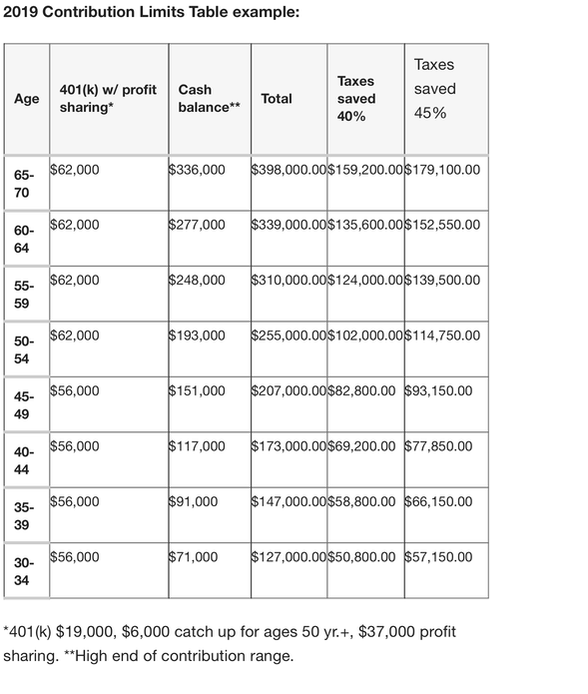
1) Multiply retirement savings: Doubled or even quadrupled annual retirement plan savings are possible. A 401(k) plan allows contributions of up to $19,000 per year plus an extra $6,000 per year “catch up” for individuals 50 years old and over. Profit sharing allows up to an additional $37,000 for a total of $62,000 per year. A cash balance plan allows an extra $55,000 to $336,000 of deductible savings.
2) Tax deduction: A medical practice can deduct all contributions made for employees. As individuals, medical practice owners and partners may deduct dollar for dollar the money invested into a cash balance plan. Typically, this can be much larger than even the homeowner's mortgage interest payments deduction.
3) Tax deferral: Money is invested tax deferred and may ultimately be rolled into an IRA account where it will continue to grow tax deferred. 
4) Tax savings: At a 40 percent tax rate, the savings can range from $22,000 to $136,00 per year. This is money that would have gone to the IRS in taxes, but instead it is invested to grow, tax deferred. 
5) Attract and retain employees: Cash balance plans are very attractive to current and future partners and employees. When a cash balance plan is implemented, retirement plan participation improves. 
6) Protection from creditors: As a qualified retirement plan, the cash balance plan assets are protected from creditors. This includes protection from bankruptcy proceedings andcivil lawsuits.
7) On-time, comfortable retirement: Cash balance plans allow significant annual contributions from $55,000 to $340,000, depending on variables including age and income. They allow physicians to catch up and save an adequate amount of money for a comfortable retirement.

Picture

During their careers, physicians expertly provide care for their patients while often neglecting their own financial health. A cash balance plan will put more of their hard-earned money to work for them, instead of into the hands of the IRS. By the time retirement comes, these physicians will have enough savings to last all through their retirement years. 
 
Seth Swenson, MBA, is president of Orchid Wealth Management in Palo Alto, CA. He may be reached at [email protected] or (650) 334-6104 ​
1 Comment

Refinance your investment portfolio

8/6/2017

1 Comment

 
My recently published article in Medical Economics compares the refinancing of a loan into a lower interest rate, to the lowering your investment portfolio's annual investment fees. The type of savings that may be achieved over the long run is similar and can have a major impact on your retirement goals. Whether it is a home loan, student loan, business loan, or even credit card debt, we can all understand how a lower interest rate benefits us and our finances. Yet when it comes to our investment portfolios we typically are not aware of the ongoing "little expenses" we are being charged, and in fact event if we are aware of them we pay little attention to these ongoing fees. This is a major investment mistake and one that most investors make. Reviewing a portfolio for excessive fees is painless and can make all the difference between retiring on-time, and having to work additional years in order to reach your financial goals. Please contact me directly for a complimentary portfolio review, and if you have any questions about this important subject.  [email protected]  | (503) 928-6678 or (650)334-6104
Picture
Picture
​Refinance Your Investment Portfolio
Seth Swenson, MBA, President at Orchid Wealth Management
 
Most people understand the benefits of refinancing their home loan or student loan. By lowering the annual interest rate, the owner of the home is able to reduce the loan payments and achieve greater leverage and purchasing power. Over the life of the mortgage, the savings in interest payments can be tremendous.
However, when it comes to investments such as mutual funds and exchange traded funds (ETF’s), most people bury their heads in the sand and cringe at the thought of figuring out how to reduce their investment’s annual expenses. This can be a huge mistake.

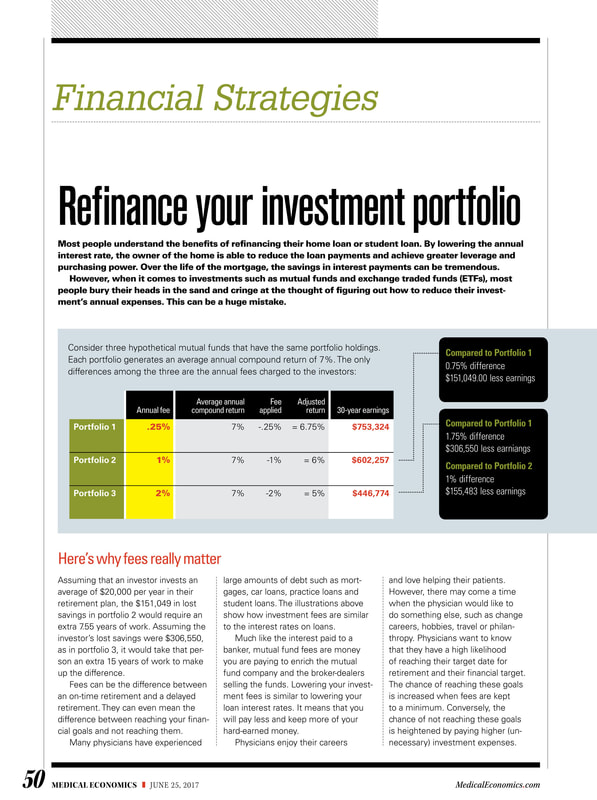
Consider three hypothetical mutual funds that have the same portfolio holdings. Each portfolio generates an average annual compound return of 7%. The only differences among the three are the annual fees charged to the investors:
Portfolio 1 is charged annual fees of .25%, portfolio 2 is charged 1% and portfolio 3 is charged 2%. The three portfolios start with $100,000 and are invested for 30 years.
Portfolio 1 earns 7% - 0.25% = 6.75%.  At the end of 30 years it will have earned $753,324.
Portfolio 2 earns 7% - 1% = 6%. At the end of 30 years it will have earned $602,257. This 0.75% difference results in $151,049.00 less earnings than portfolio 1.
Portfolio 3 earns 7% - 2%= 5%. At the end of 30 years, it will have earned $446,774.00. This 1.75% difference results in $306,550 less earnings than portfolio 1. The 1% difference between Portfolio 3 and Portfolio 2 results in $155,483 less earnings.
Here’s why fees really matter
Assuming that an investor invests an average of $20,000 per year in their retirement plan, the $151,049 in lost savings in portfolio 2 would require an extra 7.55 years of work. Assuming the investor’s lost savings were $306,550, as in portfolio 3, it would take that person an extra 15 years of work to make up the difference!
Fees can be the difference between an on-time retirement and a delayed retirement. They can even mean the difference between reaching your financial goals and not reaching them.
Many physicians have experienced large amounts of debt such as mortgages, car loans, practice loans and student loans. The illustrations above show how investment fees are similar to the interest rates on loans. Much like the interest paid to a banker, mutual fund fees are money you are paying to enrich the mutual fund company and the broker-dealers selling the funds. Lowering your investment fees is similar to lowering your loan interest rates. It means that you will pay less and keep more of your hard-earned money.
Physicians enjoy their careers and love helping their patients. However, there may come a time when the physician would like to change their daily routine and do something else, such as change careers, hobbies, travel or philanthropy. Physicians want to know that they have a high likelihood of reaching their target date for retirement and their financial target. The chance of reaching these goals is increased when fees are kept to a minimum. Conversely, the chance of not reaching these goals is heightened by paying higher (unnecessary) investment expenses.
What are these fees?
Here’s what some of the most common fees really mean.
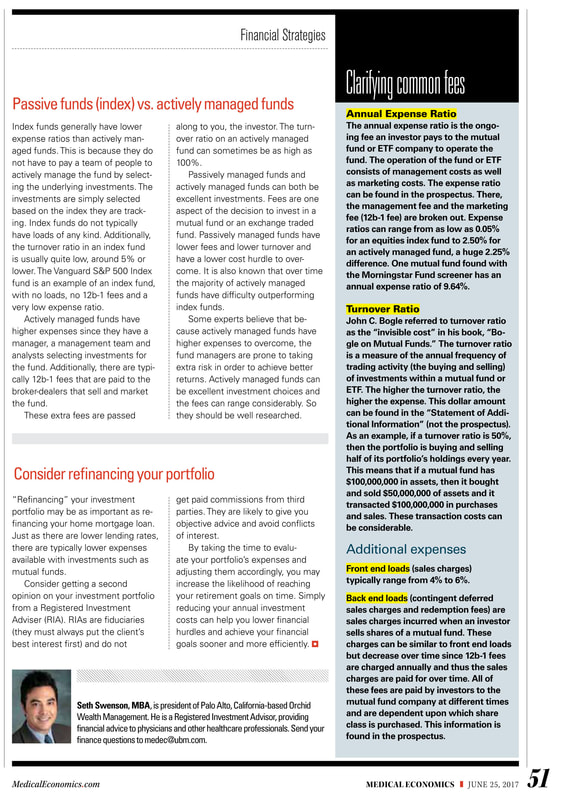
Annual Expense Ratio: The annual expense ratio is the ongoing fee an investor pays to the mutual fund or ETF company to operate the fund. The operation of the fund or ETF consists of management costs as well as marketing costs. The expense ratio can be found in the prospectus. There, the management fee and the marketing fee (12b-1 fee) are broken out. Expense ratios can range from as low as 0.05% for an equities index fund to 2.50% for an actively managed fund, a huge 2.25% difference. One mutual fund found with the Morningstar Fund screener has an annual expense ratio of 9.64%.
Turnover Ratio: John C. Bogle referred to turnover ratio as the “invisible cost” in his book, Bogle on Mutual Funds. The turnover ratio is a measure of the annual frequency of trading activity (the buying and selling) of investments within a mutual fund or ETF. The higher the turnover ratio, the higher the expense. This dollar amount can be found in the “Statement of Additional Information” (not the prospectus). As an example, if a turnover ratio is 50%, then the portfolio is buying and selling half of its portfolio’s holdings every year. This means that if a mutual fund has $100,000,000 in assets, then it bought and sold $50,000,000 of assets and it transacted $100,000,000 in purchases and sales. These transaction costs can be considerable.  
Additional expenses: Front end loads (sales charges) typically range from 4% to 6%. Back end loads (contingent deferred sales charges and redemption fees) are sales charges incurred when an investor sells shares of a mutual fund. These charges can be similar to front end loads but decrease over time since 12b-1 fees are charged annually and thus the sales charges are paid for over time. All of these fees are paid by investors to the mutual fund company at different times and are dependent upon which share class is purchased. This information is found in the prospectus.
Passive funds (index) vs. actively managed funds
Index funds generally have lower expense ratios than actively managed funds. This is due to the fact that they do not have to pay a team and a staff of people to actively manage the fund by selecting the underlying investments. The investments are simply selected based on the index they are tracking. Index funds do not typically have loads of any kind. Additionally, the turnover ratio in an index fund is usually quite low, around 5% or lower. The Vanguard S&P 500 Index fund is an example of an index fund, with no loads, no 12b-1 fees and a very low expense ratio.
Actively managed funds have higher expenses since they have a manager, a management team and analysts selecting investments for the fund. Additionally, there are typically 12b-1 fees that are paid to the broker-dealers that sell and market the fund. These extra fees are passed along to you, the investor. The turnover ratio on an actively managed fund can sometimes be as high as 100%.
Passively managed funds and actively managed funds can both be excellent investments. Fees are one aspect of the decision to invest in a mutual fund or an exchange traded fund. Passively managed funds have lower fees and lower turnover and have a lower cost hurdle to overcome. It is also known that over time the majority of actively managed funds have difficulty outperforming index funds.
Some experts believe that because actively managed funds have higher expenses to overcome, the fund managers are prone to taking extra risk in order to achieve better returns. Actively managed funds can be excellent investment choices and the fees can range considerably. So they should be well researched. 
Consider refinancing your portfolio
“Refinancing” your investment portfolio is powerful and may be as important as refinancing your home mortgage loan. Just as there are lower lending rates, there are typically lower expenses available with investments such as mutual funds.
Consider getting a second opinion on your investment portfolio from a Registered Investment Adviser (RIA). RIA’s are fiduciaries (they must always put the client’s best interest first) and do not get paid commissions from third parties. They are likely to give you objective advice and avoid conflicts of interest.
By taking the time to evaluate your portfolio’s expenses and adjusting them accordingly, you may increase the likelihood of reaching your retirement goals on time. Simply reducing your annual investment costs can help you lower financial hurdles and achieve your financial goals sooner and more efficiently.
Seth Swenson, MBA is President at Orchid Wealth Management, a Registered Investment Advisor, providing financial advice to physicians and other healthcare professionals. Palo Alto, California.
1 Comment
<<Previous

    Author

    Seth Swenson, MBA 
    President and Lead Advisor at Orchid Wealth Management.

    Archives

    October 2026
    September 2026
    January 2025
    May 2023
    March 2022
    April 2019
    February 2019
    August 2017
    May 2017
    April 2017
    March 2017

    Categories

    All

    RSS Feed

​Orchid Wealth Management is a Registered Investment Advisor. Registered in the State of Oregon. 
​Headquarters: 2015 NW Kearney St. #102, Portland, OR 97209
​WEBSITE CONTENT DISCLOSURE
 
All written content on this site is for information purposes only. Opinions expressed herein are solely those of Orchid Wealth Management unless otherwise specifically cited.  Material presented is believed to be from reliable sources and no representations are made by our firm as to another parties’ informational accuracy or completeness.  All information or ideas provided should be discussed in detail with an advisor, accountant or legal counsel prior to implementation.  

This website may provide links to others for the convenience of our users.  Our firm has no control over the accuracy or content of these other websites.


REGISTRATION INFORMATION
 
Advisory services are offered through Orchid Wealth Management; a Registered Investment Adviser currently registered in Oregon. 


The presence of this website on the Internet shall not be directly or indirectly interpreted as a solicitation of investment advisory services to persons of another jurisdiction unless otherwise permitted by statute.
 
Follow-up or individualized responses to consumers in a particular state by our firm in the rendering of personalized investment advice for compensation shall not be made without our first complying with jurisdiction requirements or pursuant an applicable state exemption.

For information concerning the status or disciplinary history of a broker-dealer, registered investment advisor, or their representatives, a consumer should contact their state securities administrator.

​
Home | About | Individuals | Plan Sponsors | Vegan & Values-Aligned Investing | Blog | Contact | Privacy Policy
Photos from Marco Verch (CC BY 2.0), verchmarco
  • Home
  • About
  • Individuals
  • Plan Sponsors
  • Cash Balance Plans
  • Blog
  • Contact
  • Privacy Policy